

Flat Roof Repair: Issues by Material & When to Call a Pro
August 03,2026
13 Minute Read
Flat roof repair is a routine part of owning a commercial building, but the right approach depends heavily on which roofing material you have and how the problem is behaving. A TPO membrane fails differently than a built-up roof, and knowing what to watch for on your specific system helps you catch issues early and avoid costly disruptions to your business. This guide breaks down the common problems by material, the issues shared across all flat roofs, and the clear signs it is time to call a professional.
Here is what you will learn:
- Issues by material: The common problems specific to each flat roof type.
- Repair costs: What commercial flat roof repair typically runs and what drives the price.
- When to call a pro: The signs that a repair needs professional attention.
Why Flat Roofs Need a Material-Specific Approach
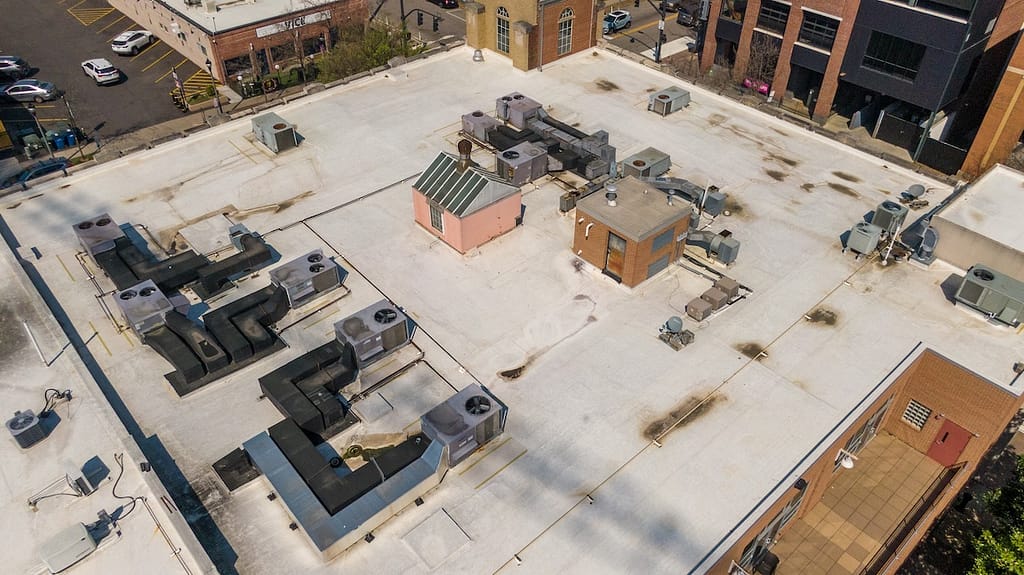
Commercial flat roofs come in several materials, each with its own strengths and failure patterns, so effective repair starts with knowing your system. Understanding these differences helps you protect your investment.
Flat Roofs Fail Differently Than Sloped Roofs
Flat and low-slope commercial roofs face a challenge that steep roofs do not: they cannot shed water quickly, so drainage and seam integrity become critical. Instead of gravity carrying water off in seconds, a flat roof relies on slope, drains, and scuppers to move water, and any weakness lets water sit and work into the assembly. This is why flat roof problems often center on drainage, seams, and flashing rather than individual shingles. Recognizing this fundamental difference is the starting point for smart flat roof maintenance.
- No quick shedding: Flat roofs cannot drain by gravity like steep roofs.
- Drainage-dependent: Slope, drains, and scuppers do the work.
- Water sits: Any weakness lets water linger and intrude.
- Different failures: Problems center on seams, drainage, and flashing.
Proper Slope Is Built Into the Code
Even a flat roof is designed with a slight slope to move water toward drains, and that slope is a code requirement, not an option. According to the International Building Code, membrane roof systems on low-slope commercial buildings require a minimum slope of one-quarter inch per foot to ensure positive drainage (Source: International Code Council, International Building Code – low-slope roof drainage requirements). When that slope is compromised by a sagging deck, compressed insulation, or poor design, water ponds and problems follow. For commercial building owners across West Des Moines and surrounding areas, understanding that drainage is designed in helps explain why standing water is always a warning sign.
- Slope is required: Code calls for a minimum quarter inch per foot.
- Positive drainage: The goal is water moving to drains, not sitting.
- When it fails: Sagging or compressed insulation defeats the slope.
- Standing water: Always a sign something is wrong.
5 Common Flat Roof Materials and Their Issues
The materials below are the most common on commercial flat roofs, each with its own typical failure points. This section introduces them, then breaks down the issues specific to each so you know what to watch for on your building.
1. TPO Membrane Issues
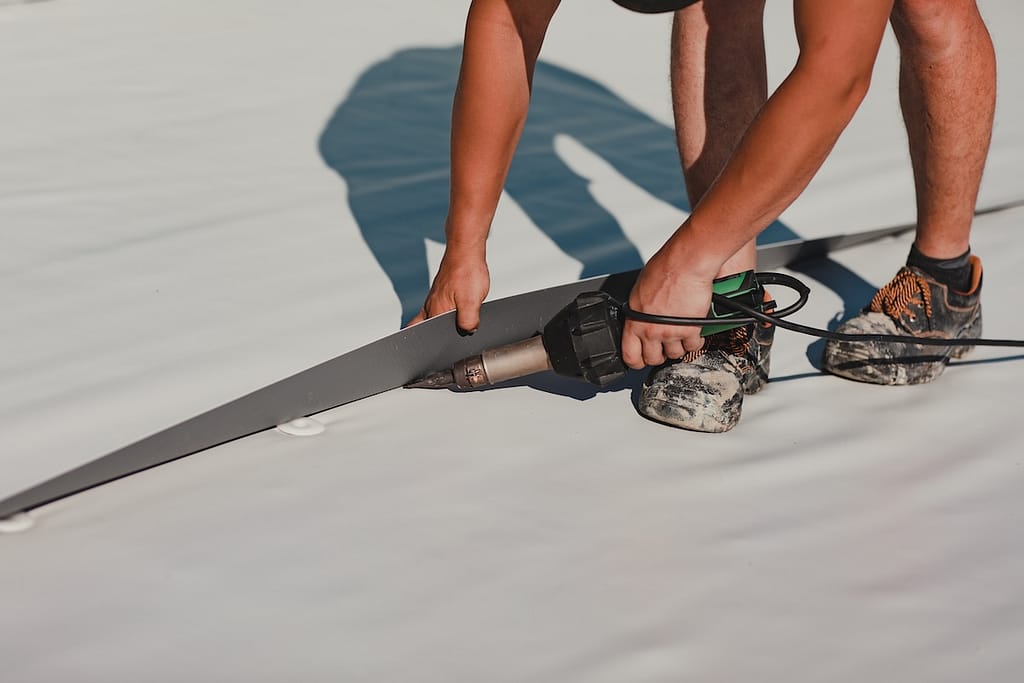
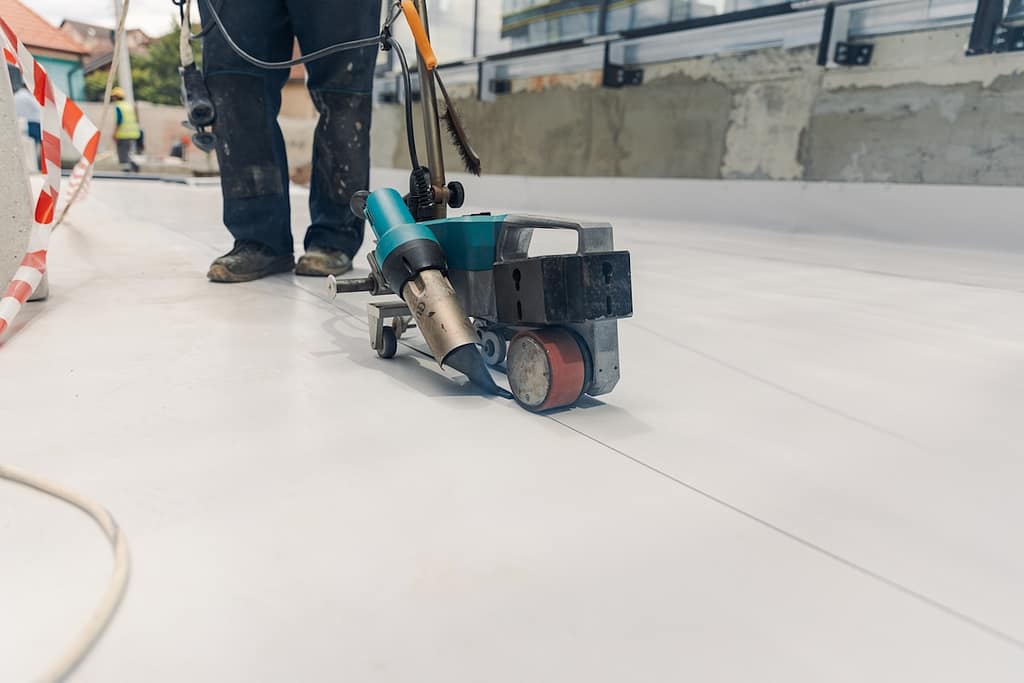
TPO is a popular single-ply membrane valued for its energy efficiency, but its most common problems occur at the seams and around penetrations. TPO seams are heat-welded, and if a weld was weak or has aged, it can separate and let water in, which is the leading failure point for these roofs. Punctures from foot traffic or debris and shrinkage over time can also create vulnerabilities. Regular seam inspection is key to catching TPO issues before they leak.
- Seam separation: Weak or aged welds are the top failure point.
- Punctures: Foot traffic and debris can pierce the membrane.
- Shrinkage: The membrane can pull at edges and penetrations over time.
- Watch the seams: Regular inspection catches problems early.
2. EPDM Rubber Issues
EPDM is a durable rubber membrane known for longevity, but it is prone to shrinkage, seam failure, and punctures as it ages. Over years of sun exposure, EPDM can shrink and pull at seams and flashing, breaking the watertight seal, while the adhesive at seams can degrade. Like other single-ply systems, it is also vulnerable to punctures from traffic and debris. Inspecting seams, flashing, and the membrane surface helps keep an EPDM roof watertight.
- Shrinkage: Aging rubber can pull at seams and flashing.
- Seam adhesive: Bonds can degrade and separate over time.
- Punctures: Traffic and debris can pierce the membrane.
- Key checks: Inspect seams, flashing, and the surface.
3. Modified Bitumen Issues
Modified bitumen roofs are tough and traffic-resistant, but they can develop blisters, seam issues, and surface cracking as they age. Blisters form when moisture or air is trapped between layers, and these can eventually rupture and leak, while seams between rolls can separate if not properly sealed. UV exposure can also dry and crack the surface over the years. Watching for blisters, cracks, and seam separation helps catch modified bitumen problems early.
- Blistering: Trapped moisture or air forms bubbles that can rupture.
- Seam separation: Joints between rolls can fail.
- Surface cracking: UV exposure dries and cracks the surface.
- Early signs: Watch for blisters, cracks, and open seams.
4. Built-Up Roof (BUR) Issues
Built-up roofing, the classic layered tar-and-gravel system, is durable but prone to blistering, cracking, and problems from shifting gravel and aging felts. Over time, the multiple layers can blister or split, and the gravel surfacing can shift to expose the membrane below. Flashing details and low spots that pond water are also common trouble areas on BUR systems. Because these roofs hide damage under gravel, professional inspection is especially valuable.
- Blistering and splitting: Aging layers can bubble and crack.
- Shifting gravel: Displaced surfacing exposes the membrane.
- Ponding spots: Low areas collect water and accelerate wear.
- Hidden damage: Gravel makes professional inspection important.
5. Metal Flat Roof Issues
Low-slope metal roofs are long-lasting, but they can develop issues with fasteners, seams, sealant, and corrosion over time. Fasteners can back out with thermal expansion, seams and sealant can fail, and any breach in the protective coating can allow rust to start. Standing water and debris that trap moisture against the metal accelerate corrosion. Inspecting fasteners, seams, and coatings keeps a metal flat roof performing.
- Fastener issues: Thermal movement backs fasteners out.
- Seam and sealant failure: These break down and let water in.
- Corrosion: Coating breaches allow rust to develop.
- Regular checks: Inspect fasteners, seams, and coatings.
Problems Every Flat Roof Shares
Beyond material-specific issues, all flat roofs share a few common problems tied to their low slope. Knowing these helps you spot trouble on any system.
Ponding Water Is the Universal Enemy
Standing water that remains on a flat roof more than 48 hours is a problem for every roofing material, accelerating wear and adding structural load. Ponding stresses the membrane, promotes algae and vegetation growth, and adds significant weight that can deflect the deck and create even more ponding. It often signals a drainage failure, a sagging deck, or compressed insulation that has defeated the roof’s slope. Persistent ponding is one of the most important issues to address on any flat roof.
- The 48-hour rule: Water remaining that long signals a problem.
- Accelerates wear: Standing water breaks down every material.
- Adds load: Water weight can deflect the deck and worsen ponding.
- Address it: Persistent ponding needs professional attention.
Flashing and Penetration Leaks Are Common
Just like sloped roofs, flat roofs are most vulnerable where the surface is interrupted, so flashing and penetrations are frequent leak sources. Rooftop HVAC units, vents, drains, and parapet walls all require proper flashing, and these transitions are where seals commonly fail. Because commercial roofs often have extensive rooftop equipment, they have many of these vulnerable points. Careful inspection of every penetration and transition is essential on a flat roof.
- Vulnerable transitions: Penetrations and edges leak most.
- Rooftop equipment: HVAC units and vents need proper flashing.
- Many points: Commercial roofs have numerous penetrations.
- Inspect each: Check every transition and penetration.
What Commercial Flat Roof Repair Costs
Cost is one of the first questions building owners ask, and understanding the ranges helps you budget and evaluate quotes. Repair pricing depends on the material, the size and location of the damage, and access.
Typical Repair Cost Ranges
Commercial flat roof repairs are usually priced per square foot, and the range varies by membrane and the extent of the damage. According to 2026 cost data compiled by Fixr, professional flat roof repair generally runs from about $2 to $10 per square foot, with the material driving much of the difference. A small, isolated patch on a sound roof can cost a few hundred dollars, while a larger damaged area, wet insulation, or multiple leak points push the total much higher. Getting an itemized estimate after a professional inspection is the only way to know your real number.
- Typical range: Roughly $2 to $10 per square foot for repairs.
- Small patches: An isolated fix can be a few hundred dollars.
- Larger damage: Wet insulation and multiple leaks raise the total.
- Get an estimate: An inspection gives you an accurate figure.
How Cost Varies by Material
Repair cost differs by membrane because some systems take more time and skill to fix than others. Built-up roofs are often the least expensive to patch, commonly in the range of $3 to $7 per square foot, while EPDM repairs that require careful seam work tend to run higher, around $5 to $10 per square foot. TPO seam and puncture repairs and metal roof repairs also fall toward the middle and upper end of that spread, depending on the fix. Knowing where your material sits helps you anticipate the cost of keeping it watertight.
- Built-up roof: Often the most affordable to patch.
- EPDM: Seam repairs take more labor and cost more.
- TPO and metal: Typically mid-to-upper range depending on the fix.
- Material matters: Your membrane shapes the repair cost.
Why Small Repairs Save Big Money
The single most expensive thing in commercial roofing is waiting, because a minor issue left alone can multiply into a major capital expense. A simple seam or flashing repair handled early might cost a few hundred dollars, but once water gets past the membrane and soaks the insulation or reaches the deck, the cost to fix it can climb dramatically. Wet insulation often has to be removed and replaced, and a rotted deck adds structural work. Addressing small problems promptly is almost always the far cheaper path.
- Waiting is costly: Small issues multiply when ignored.
- Water spreads: Wet insulation and deck rot add major expense.
- Early fixes win: A prompt repair prevents a capital project.
- Protect the budget: Prevention beats emergency replacement.
When to Call a Professional
Some flat roof issues can wait for a scheduled inspection, while others need prompt professional attention. Knowing the difference protects your building and your budget.
The Signs It’s Time to Call a Pro
Call a professional promptly for active leaks, persistent ponding, visible membrane damage, or any interior water signs, since these indicate the roof is no longer protecting the building. Widespread blistering, separated seams, damaged flashing, and sagging areas all warrant professional evaluation before they worsen. Because commercial roof problems can disrupt operations and damage inventory or equipment, early professional attention is almost always the cost-effective choice. A qualified contractor can diagnose the real issue and recommend the right repair.
- Active leaks: Any water intrusion needs prompt attention.
- Persistent ponding: Standing water signals a drainage failure.
- Visible damage: Blisters, open seams, and damaged flashing.
- Protect operations: Early action prevents business disruption.
Why Professional Inspection Pays Off
Regular professional inspections catch small flat roof issues before they become major failures, which is especially valuable on a commercial building. A trained contractor knows the failure patterns of your specific membrane, can spot subtle problems from seams to drainage, and can document conditions for warranty and budgeting purposes. Scheduling inspections, ideally twice a year and after major storms, turns roof care into a predictable plan rather than an emergency. For commercial owners, that predictability protects both the building and the bottom line.
- Catches issues early: Small problems are cheaper to fix.
- Material expertise: Pros know your membrane’s failure patterns.
- Documentation: Inspections support warranties and budgeting.
- Predictable care: A maintenance plan beats emergency repairs.
Frequently Asked Questions
How much does commercial flat roof repair cost?
Flat roof repair generally runs from about $2 to $10 per square foot depending on the membrane and the extent of the damage, with small isolated patches costing a few hundred dollars and larger repairs involving wet insulation or multiple leaks costing considerably more. Built-up roofs are often the cheapest to patch, while EPDM seam repairs tend to run higher. The best way to get an accurate figure is a professional inspection and detailed estimate.
How long do commercial flat roofs last?
Lifespan depends on the material, installation, and maintenance, with single-ply membranes like TPO and EPDM commonly serving 20 to 30 years and built-up and modified bitumen systems in a similar range. Regular maintenance and prompt repairs help a flat roof reach the top of its range. Ponding and neglect shorten it considerably.
Is ponding water on a flat roof a serious problem?
Yes. Water that remains more than 48 hours accelerates membrane wear, adds structural load, and often signals a drainage or slope problem. Left unaddressed, ponding can shorten a roof’s life significantly and lead to leaks. It should be evaluated by a professional.
Can a flat roof be repaired, or does it need full replacement?
It depends on the extent of the damage. Isolated seam separations, punctures, or flashing issues can usually be repaired, while widespread membrane failure, extensive ponding, or a roof near the end of its life may call for replacement. An honest contractor will assess which option makes sense for your building.
How often should a commercial flat roof be inspected?
A common recommendation is at least twice a year, ideally in spring and fall, plus after any major storm. Regular inspections catch small issues before they disrupt your business. Buildings with extensive rooftop equipment or older membranes may benefit from more frequent checks.
What is the most common cause of flat roof leaks?
Flat roof leaks most often start at seams, flashing, and penetrations, along with areas of persistent ponding. These are the points where the membrane is interrupted or where water is allowed to sit. A thorough professional inspection checks all of these vulnerable areas.
Why Heartland Is a Smart Choice for Commercial Flat Roof Repair
When your building depends on the roof over it, you want a commercial roofing partner who knows the failure patterns of your specific system and gives you honest guidance on the right repair. Heartland Roofing, Siding & Solar helps commercial property owners across West Des Moines and surrounding areas diagnose flat roof issues accurately, from seams and flashing to drainage and ponding, and make repairs that protect both the building and daily operations. With an A+ BBB rating and a commitment to quality workmanship, Heartland approaches flat roof care as a long-term partnership rather than a quick fix. Reach out to Heartland today for a free inspection and expert guidance on your commercial flat roof repair.

Get Started Today!
From roofing to siding, Heartland Roofing is the team you need to take your home exterior to the next level. All you need to do is reach out! Fill out our contact form or give us a call to get the reliable help that you need.


